
Finding Your Own Artistic Voice Is More Important Than Pursuing Perfection

When people think about great art, they often think about perfect realism. A portrait that looks exactly like a photograph is usually considered the highest level of artistic achievement. There is no doubt that creating such work requires tremendous skill, patience, and dedication.
But is technical perfection alone enough to create meaningful art?
Perhaps skill and art are not exactly the same thing.

Skill and Art Are Not Always the Same
Learning to draw realistically is an impressive achievement. Understanding anatomy, perspective, color, and light takes years of practice.
These skills are valuable.
However, skill alone does not necessarily create originality. Reproducing what already exists and creating something entirely new are different creative experiences.
Technique teaches us how to create.
But imagination determines what we create.
Art Is More Than Copying Reality
Reality already exists around us. Cameras can capture it, and technology can reproduce it.
Art becomes interesting when artists move beyond imitation and begin expressing their own thoughts, emotions, and ideas.
The purpose of art is not only to show what we see, but also to reveal what we feel.
Great art often comes from discovery rather than reproduction.
Finding Your Own Voice
Every artist has unique experiences, memories, emotions, and ways of seeing the world.
No school, teacher, or book can give an artist their individual voice.
That voice must be discovered through curiosity, experimentation, and personal expression.
Perhaps the most important question for an artist is not:
"How perfectly can I copy?"
but:
"What can I create that nobody else can?"
Freedom Beyond Technique
Technical skill gives artists tools, but freedom gives art meaning.
Real creativity begins when artists stop worrying about perfection and allow themselves to explore.
Sometimes a simple shape communicates more than a detailed portrait.
Sometimes an accidental brushstroke feels more honest than a carefully planned composition.
Sometimes a spill of color expresses emotion better than realistic representation.
Art becomes powerful when imagination is free from unnecessary boundaries.
Why Abstract Art Feels Emotional
Human emotions have no fixed shape.
Grief does not have a form.
Joy has no outline.
Longing cannot be measured with perspective or anatomy.
Perhaps this is why abstract art often feels so emotional.
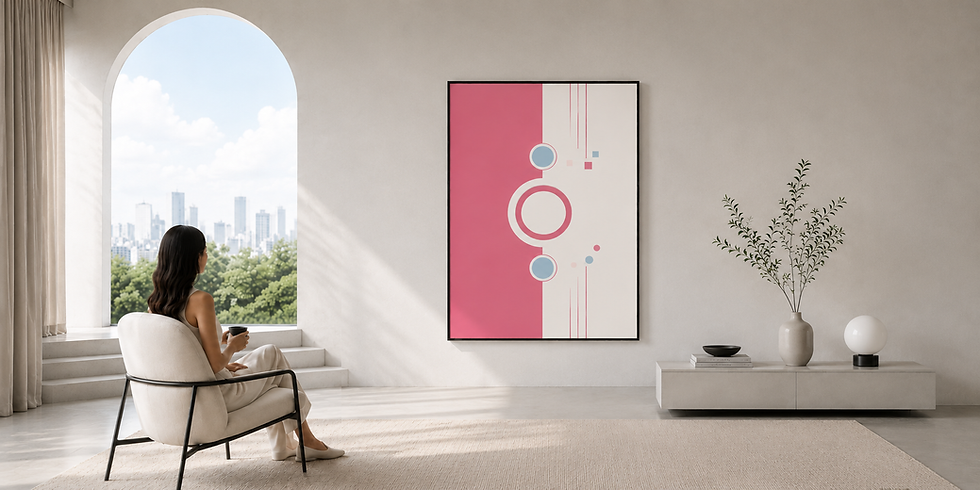
Simple colors, shapes, textures, and spaces can communicate feelings that words cannot describe.
Abstract art invites viewers to bring their own memories and emotions into the work, creating a personal connection that realistic images do not always provide.
The Value of Art Schools
Art schools provide important knowledge.
They teach anatomy, composition, perspective, color theory, and art history. These foundations are valuable and have helped generations of artists develop their abilities.
But education cannot create originality.
Schools can teach technique.
They cannot teach individuality.
At some point, every artist must move beyond formulas and discover their own path.
When Rules Become Boundaries
Rules are useful because they provide structure and understanding.
But imagination does not always follow rules.
Many important artistic movements began when artists questioned traditional ideas and explored new possibilities.
Creativity grows when artists are willing to experiment rather than simply repeat what has already been done.
Picasso and the Power of Originality
Pablo Picasso was a highly skilled artist. His early works show extraordinary realism and technical ability.
Yet Picasso is remembered not for his realistic portraits, but for Cubism and his revolutionary way of seeing.
His work changed the history of art because he dared to create something different.
His example reminds us that originality often leaves a greater impact than perfection.
Why Perfection Is Never the Final Goal
Perfection is endless.
There will always be another detail to improve and another standard to achieve.
Originality, however, creates something unique.
People may admire perfect technique, but they often remember ideas that change the way they think and see.
Unique voices leave lasting impressions.
There Is No Single Path in Art
Realism is art.
Abstract art is art.
Minimalism is art.
Symbolism is art.
Conceptual art is art.
There is no single definition of creativity.
Every artist must discover their own way of expressing themselves.
Conclusion
Technical skill is important, and learning the fundamentals has value.
But perhaps real art begins when imagination becomes free.
The greatest artists are remembered not because they painted perfectly, but because they showed the world something new.
Technique provides tools.
Freedom creates possibilities.
And maybe the true purpose of art is not to follow someone else's path, but to discover your own and offer the world a unique way of seeing.
Comments