
The Transformation: Allowing Myself to Dream
- Feb 16
- 5 min read
Updated: 4 hours ago
By Sachin Sathawane — Founder, Pencil Spark
I learned discipline through science, and compassion through art. Between precision and perception, I found my purpose.
The Life of Precision
There are moments when you realize you've been living on autopilot. I spent years as a laboratory scientist at a pharmaceutical company, working with precision instruments and following strict protocols. On paper, it was meaningful, respectable work. But inside, something was suffocating. The fluorescent lights, sterile corridors, and endless cycle of experiments and reports felt stifling. Despite being competent and reliable, I felt like I was disappearing.
The creative spark emerged as doodles during lunch and sketches on blank paper. I found myself captivated by the play of light and geometric patterns. These weren't distractions but lifelines. My spirit was whispering, but the laboratory was too loud to hear it clearly.

Stability vs. Spirit
I had followed the prescribed script faithfully. Graduate. Find work in a respected field. Earn well. Build a comfortable life. Receive the approval of family and friends. From the outside, it looked complete.
From the inside, it felt like a slow erosion.
Days dissolved into nights. The work continued. And beneath it all, a growing, aching sense that I was built for something the spreadsheets and safety reports could not hold. A creative energy that had no outlet. A voice that had been politely, professionally silenced for years.
I did not speak about it. I barely admitted it to myself. Because to admit it would mean facing the question I was most afraid of:
What if I walked away from everything I had built?
The Breaking Point
The turning point did not arrive dramatically. It arrived during a particularly difficult period — a season of stress and anxiety that no protocol could fix. I began attending art workshops almost accidentally. Experimenting with mediums. Sitting with colour and form and silence in a way I never had before.
And something in me recognised it immediately.
Creating became a kind of meditation. A way to quiet the noise I had been living inside for over a decade. For the first time in years, an hour could pass and I would not notice. For the first time, I was not disappearing — I was becoming more visible to myself.
I began to understand that this was not a hobby. This was not stress relief. This was the most honest thing I had ever done.
“One quiet hour of creating can change the entire direction of a life.”

The Transformation: Allowing Myself to Dream
Choosing art was not a comfortable decision. It meant uncertainty. It meant choosing meaning over security — a thing that is easy to admire in other people and terrifying to practise yourself.
The fears arrived on schedule. What will people think? What if I fail? What if eleven years of discipline and sacrifice add up to nothing?
But underneath the fear was a quieter, steadier truth: to ignore this calling would mean betraying the most essential version of myself. And that was a cost I was no longer willing to pay.
I immersed myself in learning. I built skills slowly and deliberately — the same way I would later learn to build a drawing, layer by layer, tone by tone, with patience as the only real tool. I found a community of people who understood the particular courage it takes to create something and offer it to the world.
My Drawing Style: Slow, Honest, and Human
My drawings are not rushed. They are built slowly—layer by layer—like understanding a person. I work primarily with color pencils because they demand patience and reward honesty. There is no shortcut. Every tone must be earned. Every shadow must make emotional sense. I am drawn to realism—not just visual realism, but emotional realism. I want my drawings to feel like someone is breathing behind the paper.
“Drawing is peace for me. It is meditation with a pencil.”


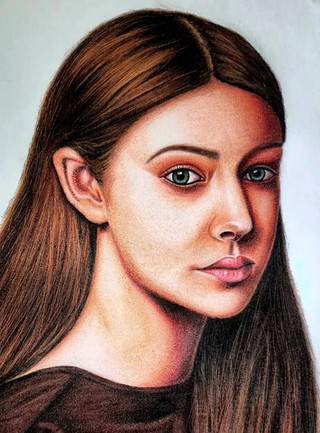


Original colour pencil drawing — built slowly, layer by layer. © Sachin Sathawane | Pencil Spark
Why Art Matters to Society
I believe the world does not only need more medicine. It needs healing of a different kind.
Healing through being seen. Through being felt. Through being understood in a language that does not require words.
When someone pauses in front of a drawing and feels something they cannot explain — and walks away slightly lighter than they arrived — that is not decoration. That is art doing its oldest and most necessary work.
After eleven years in pharmaceutical science, I chose art not because science no longer mattered, but because I recognised that some pain lives beyond the reach of any compound. Some wounds require a different kind of care. Art became my language of that care.
“Art is the journey of a free soul, the sign of ultimate freedom and dancing of imagination in the garden of dreams.”

A Message to Those Who Feel Lost
If you are reading this and feeling trapped, or broken, or unsure of the path ahead — know this:
You are not late. You are not wrong. You are becoming.
No experience is wasted. The years you spent doing something that did not feel like you were not years lost. They were years of formation. The discipline, the precision, the long practice of showing up even when it felt hollow — all of it becomes material. All of it finds its way into the work.
I did not change my profession.
I changed how I show up in the world.

What Will You Leave Behind?
Ask yourself this:
What do you want to leave behind when you're gone?
Not what career, not what status, not what income—but what will remain?
What will your grandchildren hold in their hands? What will strangers discover fifty years from now and feel moved by? What proof will there be that you existed and created something beautiful?
These aren't comfortable questions. But they're the most important ones you'll ever ask. Your journey may lead to art. Or music. Or writing. Or building. The medium doesn't matter. What matters is that you honor the voice inside you calling you to create something lasting.
Let your creativity illuminate the world. Not just while you're here—but long after you're gone. Find the spark within you.
Let it create something that will outlast you.
Let it be your gift to a future you'll never see.
That is courage. That is purpose. That is art.
Sachin Sathawane is a self-taught artist and the founder of Pencil Spark — an original art brand creating conceptual digital art and colour pencil drawings from Nagpur, India. His work ships worldwide.
pencilspark.com · Where Feeling Becomes Form.


Comments