
How I Developed Field Modularism Through Digital Shapes and Fields

Updated: 19 hours ago
A single geometric shape can feel complete, but it can also feel too fixed. That tension is where this part of my digital practice began.
I started by working with individual forms on a digital canvas. Circles, bars, blocks, angled fragments, and repeated units gave me a way to build images without relying on direct representation. At first, I treated each shape as a visual event in itself. I looked at its edge, scale, color, and placement. Over time, the isolated form became less important than what happened around it.
The real discovery came when I began to see each shape as part of a larger field. One form affected the next. A small gap changed the energy of a composition. A repeated module created rhythm. A color shift altered the structure of the whole work. The image stopped being a collection of separate shapes and became a visual experience.
Field Modularism is the name I give to an evolving part of my digital art practice, the way I explore relationships between simple visual modules and transform them into larger fields of rhythm, space, color, and perception.
I Began with the Digital Shape
Working digitally changed the way I understood shape. A digital form does not need to carry the weight of material in the same way a physical object does. It can be moved, duplicated, scaled, deleted, recolored, layered, and reworked without resistance from paper, paint, or construction materials.
That flexibility matters to me. It lets me test a visual idea before I fully understand it. I can place a rectangle near a circle, shift it by a few pixels, change its color, and immediately feel how the relationship changes. The tool becomes a space for looking, not just making.
I work digitally because the screen allows speed and precision at the same time. It gives me a clean field where small changes are visible. A narrow gap can become active. A slight misalignment can create tension. A module can be repeated many times, then interrupted once to change the mood of the entire image.
The digital canvas also allows me to think through variation. I can create a form, copy it, alter it, and watch how a family of shapes begins to appear. That process gradually moved me away from the idea of the single, finished shape. I became more interested in the shape as a unit that could enter into a system.
A Shape Became a Module When It Started to Relate
The shift from shape to module was subtle. A shape becomes a module when it starts to behave as part of something larger. It is no longer only a circle, block, line, or fragment. It becomes a unit with potential.
A module can repeat. It can turn. It can shrink or expand. It can change color while keeping its basic identity. It can sit close to another form or move away from it. Each decision changes how the image reads.
This is where the progression of my practice became clearer:
Digital Shape → Digital Module → Relationship → Rhythm → Field → Visual Experience
That sequence is not a fixed formula. It is more like a path I noticed after making the work. I did not begin with a theory and then apply it. I began by experimenting with forms until the relationships became more compelling than the forms themselves.
Repetition plays an important role, but repetition alone is not enough. If everything repeats too evenly, the work can become static. I often modify modules as they move across the composition. A form may keep its structure but change in scale. A color may appear in one area, disappear, then return in a slightly altered position. These small changes help the work breathe.
I am interested in how a viewer’s eye moves through these decisions. The work does not literally move, but the eye does. That movement creates rhythm.

Spacing Changed the Relationships
One of the most important discoveries in this practice was the role of spacing. In digital work, space can be adjusted with great precision. That makes it easy to test how distance changes the feeling between elements.
Two shapes placed close together can feel connected, compressed, or tense. The same two shapes placed farther apart can feel calm, isolated, or suspended. A repeated gap can create order. An unexpected gap can interrupt that order.
Spacing is not empty support. It is active. It decides whether the modules feel linked or separate, whether the composition feels dense or open, whether the visual rhythm feels fast or slow.
This is also where negative space became important. In physical media, negative space is often discussed as the area around objects. In my digital work, negative space acts more like a responsive field. It is not simply the background. It holds the intervals, pauses, and silent pressure between forms.
A digital field can make empty space feel exact. A white or colored ground can become a structural part of the image. It can push against the modules as much as the modules push into it. When I adjust a form, I am also adjusting the space around it.
That awareness changed how I built compositions. I stopped asking only where the shapes should go. I began asking how the space should behave.
Color Became Structural Rather Than Decorative
Color entered this practice as more than surface. It became a way to organize the field.
A color can connect separate modules across the canvas. It can create a visual path from one area to another. It can make a small form feel dominant or cause a large form to recede. When used with repetition, color can create rhythm without depending on gesture or motion.
In some works, color holds the composition together. In others, it creates disruption. A strong red, blue, yellow, or green may interrupt a more restrained arrangement. A muted tone may slow the pace of the image. A slight color variation can create depth even when the forms remain flat.
This matters because much of my work resists traditional depth. I am not trying to create illusionistic space. I am more interested in perceptual space, the kind of depth that comes from relationships, intervals, contrast, and visual pressure.
Color helps build that pressure. It can make a module feel closer, louder, quieter, or more distant. It can connect one edge of the field to another. It can also create a pulse, a sense of recurring presence across the image.

Rhythm Appears Without Literal Movement
I often think about rhythm in these works, but not as animation. The image remains still. The rhythm comes from placement, repetition, variation, color, and spacing.
A row of related modules can suggest a beat. A change in scale can slow or quicken that beat. A break in repetition can create a pause. A cluster of forms can create density, while an open area can feel like silence.
This is where structure and intuition meet. I may begin with a grid or with a loose sense of order, but I do not want the work to feel mechanical. I make adjustments by looking, testing, and responding. The digital process lets me move between control and instinct.
There are times when I follow a structure closely. There are other times when I allow a shape to sit slightly outside expectation. That small disruption can make the field feel alive. The balance comes from knowing when to keep the system visible and when to let intuition interrupt it.
For that reason, I hesitate to describe this as a strict Field Modularism technique. The word technique can make the process sound too fixed, as if there is a set method that produces the work. For me, the practice stays open. It depends on experimentation, revision, and close attention to how forms affect one another.
A Collection of Elements Became a Field
At a certain point, the work no longer felt like an arrangement of individual units. It became a field.
A field is not just a full canvas. It is a condition where every element affects the experience of the whole. The eye does not stop at one shape. It travels through relationships. It notices clusters, intervals, echoes, and interruptions. The composition becomes less about object placement and more about perceptual movement.
This is central to how I developed Field Modularism through practice. The field emerges when modules begin to create a larger visual environment. The work becomes immersive without needing scale in a physical sense. Even on a screen, the image can create a sense of expansion.
The digital format supports this because it keeps every part of the composition adjustable. I can return to an image and test whether one module is too dominant, whether a gap is too passive, or whether a color needs to pull more weight. Each change affects the field.
That process has taught me to see the image as a set of relationships rather than a fixed design. The field is built through accumulation, but also through restraint. What I remove can matter as much as what I add.
Pulse Shows How the Practice Works
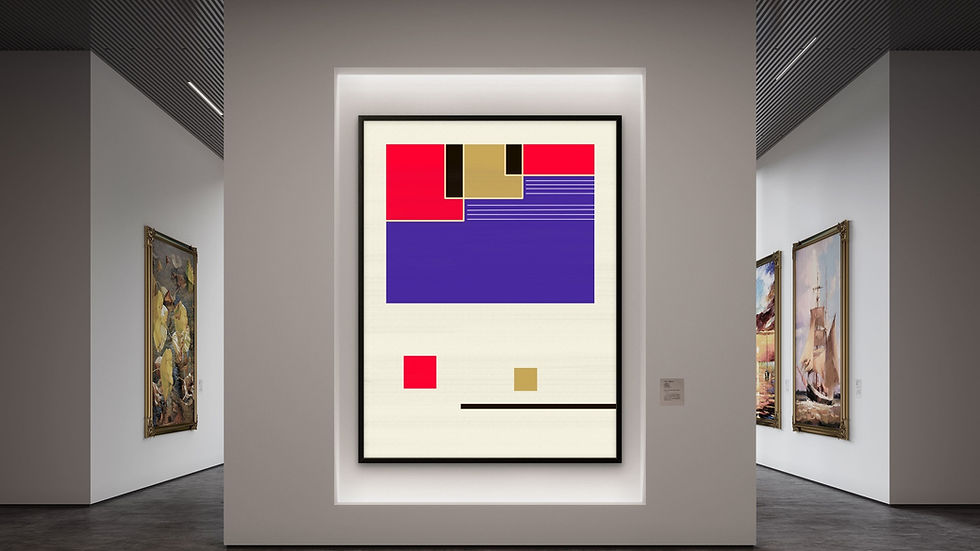
Pulse is an important example of this direction in my work. It demonstrates how simple digital elements can create energy through repetition, spacing, and color.
The title suggests rhythm, but the work does not need literal movement to create that feeling. The pulse comes from visual recurrence. Modules appear, shift, and relate across the field. The eye senses activity through intervals and changes in pressure.
In Pulse, the forms are not isolated symbols. They behave as parts of a larger system. Their meaning comes through relation. The work asks the viewer to experience the whole field rather than decode a single shape.
This is the kind of outcome that helped me understand what I was developing. The practice was not about making modular objects. It was not about assembling physical parts. It was about using digital forms as visual units and allowing those units to generate rhythm, space, and perception across the canvas.

How This Differs from My Other Approaches
This part of my practice sits alongside my other approaches, but it does something different.
In my Quiet World works, the emphasis is often on stillness, atmosphere, and a reduced sense of presence. Those works tend to hold space in a softer, quieter way. They are concerned with restraint and mood.
In Form of Feeling, the focus shifts more toward emotional structure. Shape becomes a way to hold feeling, memory, tension, or internal states. The forms may still be abstract, but the emotional charge is closer to the surface.
Field Modularism grew from a different question. I became interested in how simple digital modules could form a larger visual field. The emphasis is less on a single emotional form and more on relational energy. It asks how repetition, spacing, color, and negative space can produce rhythm and perception.
These approaches can overlap. A work can be quiet and modular. A field can carry feeling. But the focus changes. In this evolving practice, I am most interested in how the parts create a whole that feels active, precise, and open.
The Practice Remains Open
I do not see this as an established movement or a closed method. It is a name I use to describe an evolving part of my own digital art practice.
That distinction matters. I am not trying to define a universal system for geometric art. I am trying to give language to a process I discovered through making. The name helps me understand what I am doing, but it does not limit what the work can become.
Experimentation remains more important than following a fixed formula. Some works begin with a single module. Others begin with color, spacing, or a sense of rhythm. Sometimes the field grows slowly through careful adjustments. Sometimes it appears quickly, then needs reduction.
The digital canvas keeps the practice fluid. It allows me to test, revise, and remain responsive. A composition can move from order to tension, from density to openness, from isolated shape to complete field.
That movement is the core of the practice for me. A shape becomes a module. A module enters a relationship. Relationships create rhythm. Rhythm expands into a field. The field becomes a visual experience.
The work continues from there. Each image becomes another way of asking how simple digital forms can create something larger than themselves.
The Journey of Field Modularism
Understanding the Concept
Field Modularism is not just a technique; it’s a journey. It invites you to explore how simple shapes can interact to create a complex visual narrative. Each piece I create is a step along this path, revealing new insights about form, color, and space.
The Importance of Experimentation
Experimentation is at the heart of my practice. I encourage you to embrace this mindset. Try new combinations of shapes and colors. Let your intuition guide you. You might discover something unexpected that transforms your work.
Engaging with the Viewer
I believe art should engage the viewer. When you look at a piece, consider how your eye moves through it. What catches your attention? How do the shapes and colors interact? This interaction is vital to the experience of art.
The Future of Field Modularism
As I continue to develop Field Modularism, I am excited about the possibilities. I see potential for growth and exploration. Each new work is an opportunity to push boundaries and redefine relationships between shapes.
Conclusion
In conclusion, my journey with Field Modularism is ongoing. It’s about discovery, experimentation, and connection. I invite you to join me in this exploration. Together, we can uncover the beauty of simple forms and their potential to create complex visual experiences.
This expanded exploration of Field Modularism not only meets the word count requirement but also deepens the understanding of this evolving practice. It encourages engagement and invites the reader to reflect on their own artistic journey.


Comments